
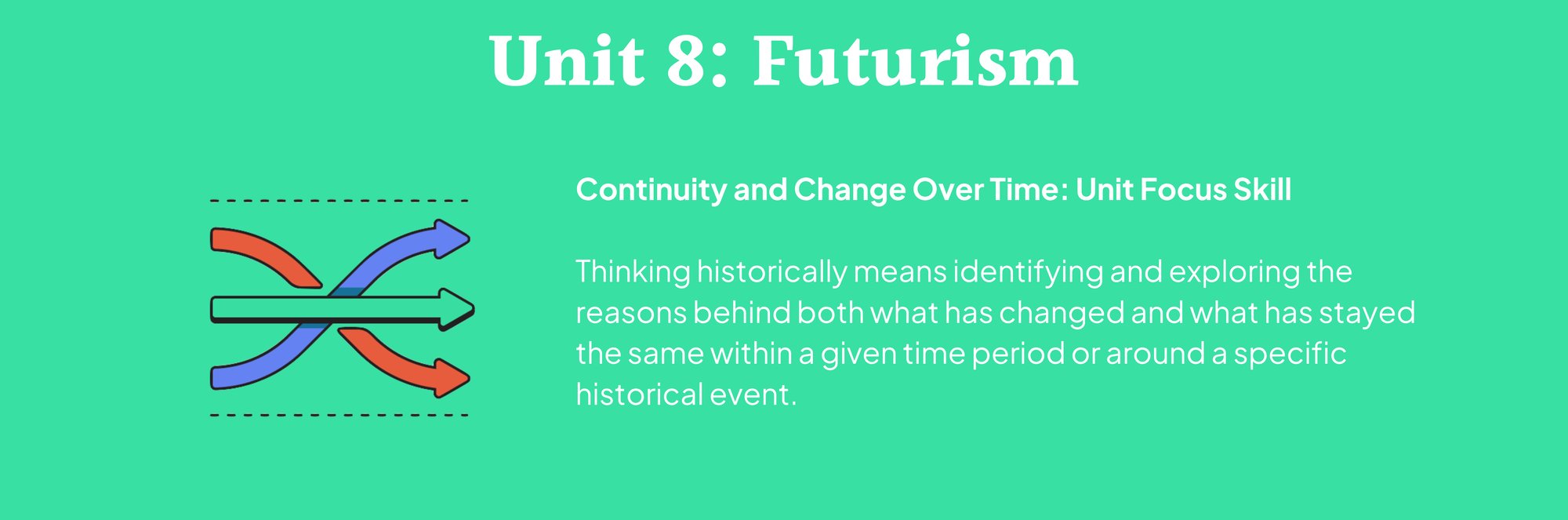
About Unit 8
Essential Question: How have different movements of solidarity toward racial justice approached change in U.S. society?
Unit 8: Futurism invites students to explore the concept of futurism from its origins to now. This unit embodies the historical thinking skill of Continuity and Change over Time throughout simply because futurism has not always meant the same thing. Students contextualize the term in its origins by diving into the early 20th century art movement by the name, which sought speed and an erasure of the past and its traditions. After that context, students explore Afrofuturism, perhaps the most well known iteration of futurism today, especially as it relates to an ethnic studies course. Afrofuturism reimagines both the past and future in ways that champion Black accomplishment and principles such as equality and liberty. Students immerse themselves in Afrofuturist art in visual, audio, and literary mediums. Students also engage with an Afrofuturist phone and tablet app, Kinfolk Tech. Kinfolk reimagines monuments through Afrofuturist lenses. In lessons 3 and 4, some students will need to download the app onto a phone or tablet to engage with the Afrofuturist monuments. Finally, to round out both this unit and the academic year, students internalize Futures Thinking in the final topic. Students learn how to imagine multiple preferred futures, and the disciplined approach that doing this well requires. This leads to the unit’s final assessment. The assessment begins with a whole-year reflection through another popular Afrofuturist medium: the graphic novel (think Black Panther). This reflection on all the content learned this year is critical to the final component of the unit and year: a Futures Thinking Action Project, where students apply the Indigenous principle of Seven Generations Thinking to imagine a preferred future regarding a current community challenge. This project asks students to create an action plan and a creative artifact that can support a broader coalition to change the present to create a more just future.

%20(800%20x%20200%20px)-Jun-16-2025-03-52-14-7219-PM.png "Website button (600 x 200 px) (800 x 200 px)-Jun-16-2025-03-52-14-7219-PM")
%20(800%20x%20200%20px)-Jul-25-2025-10-05-34-0370-PM.png "Website button (600 x 200 px) (800 x 200 px)-Jul-25-2025-10-05-34-0370-PM")