
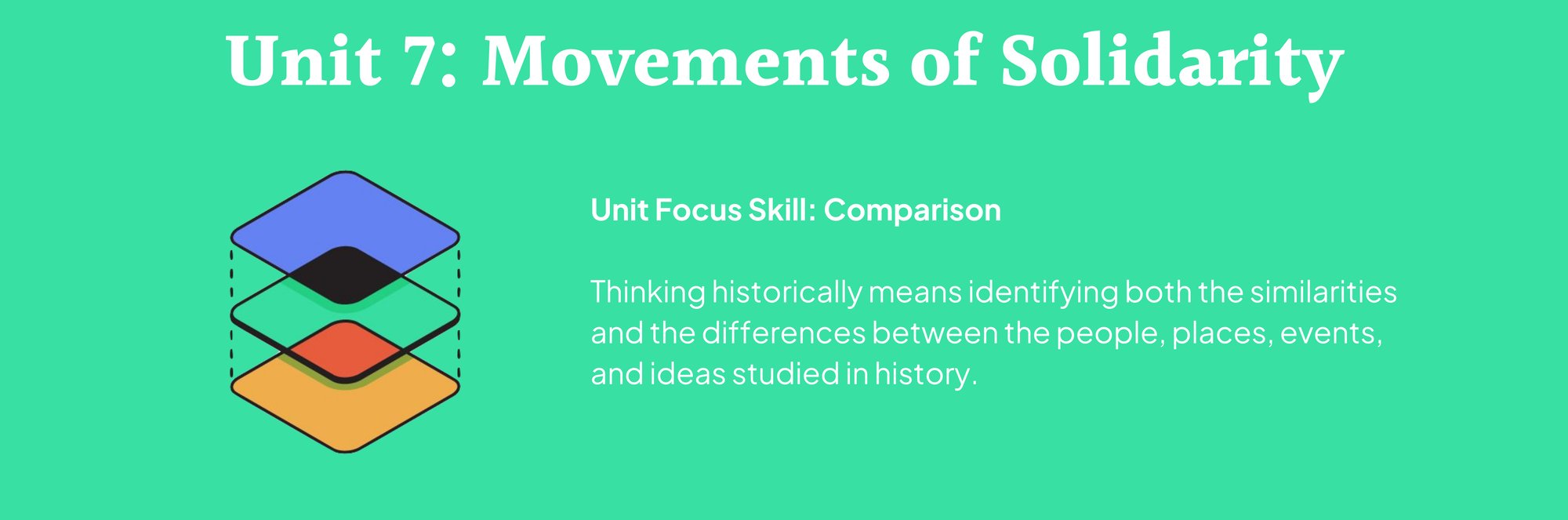
About Unit 7
Essential Question: How have different movements of solidarity toward racial justice approached change in U.S. society?
Unit 7: Movements of Solidarity invites students to investigate how different communities have organized, resisted, and built power in pursuit of racial justice in the United States. Through the lenses of comparison, historical significance, and causation, students will engage with a range of social movements—examining not only their strategies and leadership structures, but also the grassroots organizing and solidarity that made them possible. Students begin by exploring early, often overlooked forms of resistance—challenging the notion that social movements begin with singular landmark events. They then turn to the Civil Rights Movement, examining both its celebrated leaders and the many organizers whose contributions have been marginalized in public memory. From there, students investigate the Labor and Chicano Movements, centering the role of solidarity across communities in achieving meaningful change. The unit concludes with a comparative analysis of protest strategies, intersectional identities, and the forces of opposition that social movements have historically faced. Throughout the unit, students practice the disciplinary skill of Comparison—identifying similarities and differences across movements, time periods, and communities. This skill is woven intentionally into every topic and lesson, building students toward the unit's culminating assessment: a Socratic Seminar in which students engage in structured, academically productive dialogue around the essential question. Because the Socratic Seminar requires students to listen actively, build on peers' ideas, and articulate evidence-based arguments, lessons across the unit are deliberately designed with frequent opportunities for academically productive talk so that students are well-prepared for this mode of assessment.

%20(800%20x%20200%20px)-Jun-16-2025-03-52-14-7219-PM.png "Website button (600 x 200 px) (800 x 200 px)-Jun-16-2025-03-52-14-7219-PM")


%20(800%20x%20200%20px)-Jul-25-2025-10-05-34-0370-PM.png "Website button (600 x 200 px) (800 x 200 px)-Jul-25-2025-10-05-34-0370-PM")