
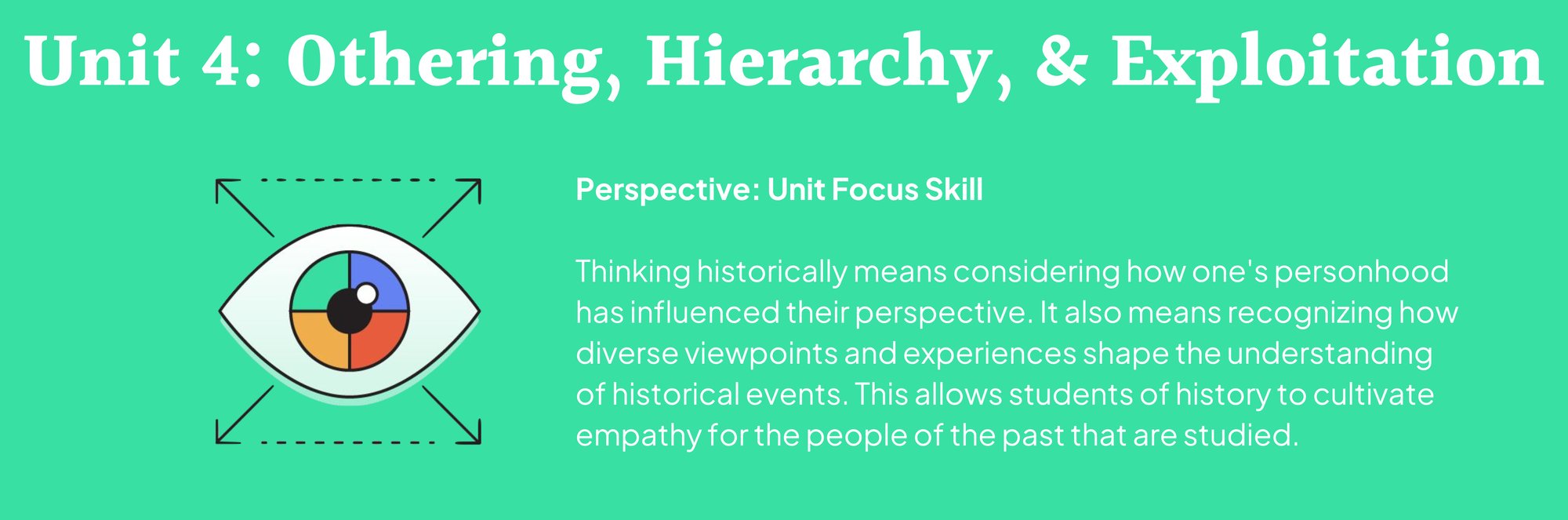
About Unit 4
Essential Question: What does the history of human “othering” and hierarchy teach about what it has meant to belong in America throughout history?
Unit 4: Human Nature, Othering, Hierarchy, and Exploitation invites students to examine how aspects of human behavior—such as the tendency to form groups and draw boundaries—have shaped systems of inequality throughout U.S. history. Through the lens of perspective, students explore how the construction of “us” and “them” has influenced ideas of freedom, belonging, and justice from the nation’s founding through World War II. Students begin by studying the roots of othering and considering how learning “hard history” can help build empathy and inclusion. They then investigate how America’s founding ideals of liberty and equality coexisted with slavery and Indigenous displacement, analyzing how Black and Indigenous peoples challenged these contradictions and pursued freedom in the Revolutionary era. In the following topics, students trace the nation’s struggle to define belonging during Reconstruction, the rise of exclusionary laws, and the persistence of white supremacy. The unit concludes with an exploration of how national crises—from the Great Depression to World War II—both relied on and betrayed the loyalty of Black and Asian Americans.

%20(800%20x%20200%20px)-Jun-16-2025-03-52-14-7219-PM.png "Website button (600 x 200 px) (800 x 200 px)-Jun-16-2025-03-52-14-7219-PM")


%20(800%20x%20200%20px)-Jul-25-2025-10-05-34-0370-PM.png "Website button (600 x 200 px) (800 x 200 px)-Jul-25-2025-10-05-34-0370-PM")